What Size Dumpster Do I Need in Manchester, NH?
From a single bathroom gut to a full demolition site, here's how to match your Manchester-area project to the right dumpster size — 10-yard through 40-yard.
Manchester dumpster guide
A general guide to recycling and responsible disposal in Hillsborough County and greater Manchester — what typically gets diverted, and where to go for specifics.

We get asked fairly often what actually happens to material once it leaves a job site in a roll-off container, and it's a fair question. The honest answer is that it depends on the material, the load, and the facility handling it — so rather than make specific claims we can't verify, here's the general picture of how responsible disposal works in Hillsborough County and greater Manchester, along with where to go for the details that matter for your specific project.
Several categories of material commonly loaded into dumpsters are handled separately from general trash specifically because they have recycling or reuse value:
Exactly which facility handles which material, and what percentage actually gets diverted versus landfilled, varies by load and by hauler agreement — that's not something we're going to state as a fixed number here, because it isn't one.
For household-level recycling questions — curbside pickup schedules, what's accepted at the curb, drop-off locations for specific materials — the City of Manchester's Trash & Recycling department is the right first call. They maintain the current, authoritative guidance for city residents, and it changes from time to time as programs are updated.
For broader questions about waste management, hazardous material disposal, or state-level environmental guidance, the NH Department of Environmental Services is the right resource. They cover Hillsborough County as well as the rest of the state and maintain guidance on categories like electronics, household hazardous waste, and larger-scale waste management questions that go beyond what a city department typically handles.
The right disposal method sometimes depends on the shape of the job as much as the material itself. A roll-off container is the right call for ongoing projects — a renovation, a cleanout, a construction job — where debris accumulates over several days and you need the container on site the whole time. If instead you've got a single load of material to move out in one trip — old appliances, a pile of scrap metal, a batch of yard debris — our junk removal service is often the more efficient option, since it doesn't require holding a container on your property for several days. Either way, the same general principle applies: materials with recycling value get handled accordingly.
On construction and renovation jobs specifically, a lot of what ends up in the dumpster is a mix by nature — drywall, framing offcuts, packaging, general debris all coming out of the same work area. That's completely normal, and it's not something a homeowner or contractor needs to sort on site for us. Where separation genuinely helps is with the dense, high-volume materials: a demolition job producing a lot of concrete, or a remodel generating a large amount of scrap metal, benefits from being called out ahead of time so we can size and price the load correctly and route the material appropriately. Our construction dumpster rental page and demolition debris page both go into more detail on how we handle those larger, heavier project types.
What we can speak to firsthand is what goes into our containers and what doesn't. Standard prohibited materials across our sizes are paint, fuel or oil, chemicals and solvents, asbestos-containing material, batteries, tires, and hazardous or medical waste — none of that belongs in a roll-off, for recycling reasons as much as safety ones. Beyond that standard list, our what can go in a dumpster guide covers the full breakdown by material type if you're planning a load and want to check something specific before the container arrives.
If you're planning a project with a meaningful amount of metal, concrete, or yard debris, the most useful thing you can do is mention it when you call to book. It doesn't change most container loads — mixed debris is normal and expected — but for larger volumes of a single material, letting us know up front means we can point you toward the service page or size that fits best, and flag anything specific to that material category.
If you're not sure how a particular material fits into all this, call us at (603) 634-9248 and we'll talk through it. For household program specifics, the City of Manchester's Trash & Recycling department and the NH Department of Environmental Services are the two resources worth having bookmarked — we're glad to point you to the right one depending on your question, but we'd rather send you to the department that actually maintains that guidance than guess at it ourselves.
FAQs
Metal, concrete and masonry, and yard waste like brush and branches are the categories most commonly diverted where local infrastructure allows. Exactly how much of a given load gets recycled versus landfilled depends on the material and the facility handling it.
The City of Manchester's Trash & Recycling department maintains current, authoritative guidance on curbside pickup, what's accepted, and drop-off locations for city residents.
The NH Department of Environmental Services covers Hillsborough County and the rest of the state, including guidance on electronics, household hazardous waste, and larger waste management questions beyond city-level programs.
Mixed loads are normal, but if you're generating a significant volume of concrete or metal specifically, mention it when you book. Concrete in particular is priced and sized differently — see our concrete and heavy debris page for details.
No. Standard prohibited materials are paint, fuel or oil, chemicals, asbestos, batteries, tires, and hazardous or medical waste. Yard waste has a separate list that includes treated or pressure-treated wood, plastic planters, fertilizers, chemicals, and bagged household trash.
Ready when you are
Call and you will speak to someone local who knows the streets, the permit rules and which box actually fits your driveway. Flat rate quoted up front.
Keep reading
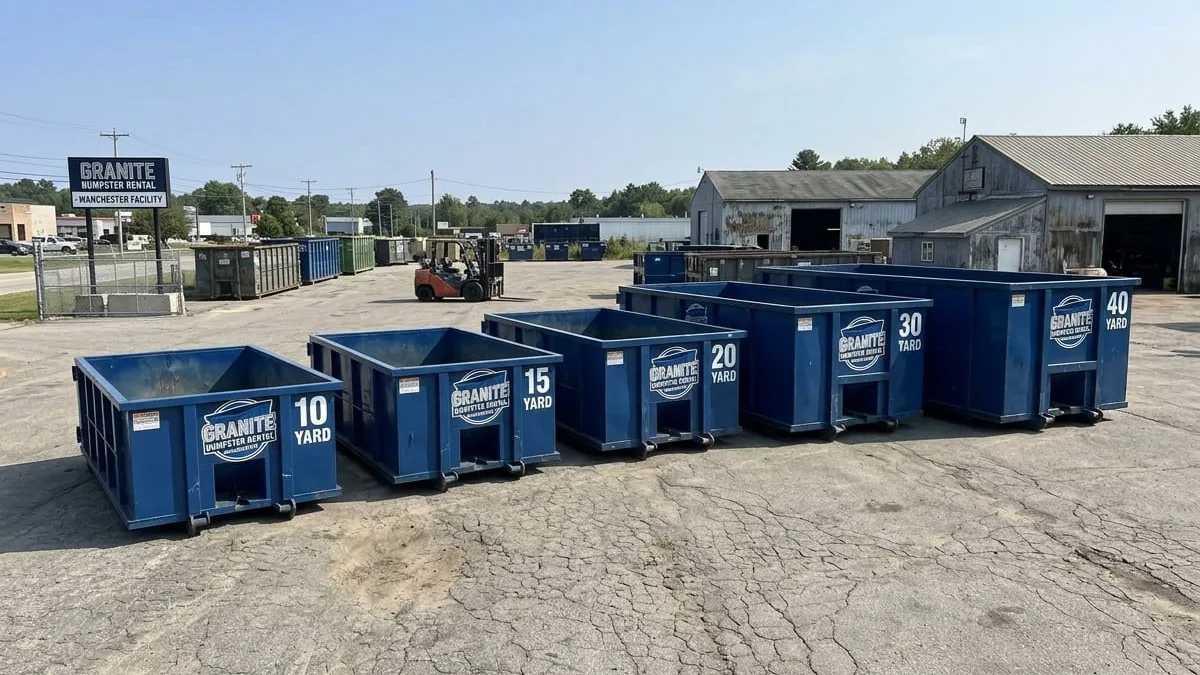
From a single bathroom gut to a full demolition site, here's how to match your Manchester-area project to the right dumpster size — 10-yard through 40-yard.
Dumpster pricing isn't a mystery once you know the factors. Here's what actually drives cost in Manchester — and why only our 10-yard has a published price.
Most household and construction debris is fair game — but a short list of items isn't. Here's what's accepted and prohibited, including the separate rules for yard waste.